
Saudi Arabia's Oil Gamble: Why They Cut Production
Saudi Arabia's calculated OPEC+ production cuts prioritize funding its Vision 2030 economic transformation by defending global oil prices, even at the risk of severe diplomatic friction with the United States.
Saudi Arabia's Oil Gamble: Why They Cut Production
In October 2022 and again in April 2023, Saudi Arabia engineered coordinated OPEC+ production cuts that triggered severe diplomatic friction with the United States. These structural interventions sent an unambiguous signal to international energy markets regarding Riyadh's changing macroeconomic framework.
These production rollbacks were far from standard, reactionary market balancing. They represented a calculated, long-term choice: Saudi Arabia concluded that its core interests were optimized by defending global energy prices to fund its vast domestic economic overhaul, rather than by accommodating Washington’s political preferences ahead of the U.S. midterm elections. To understand this assertiveness, one must analyze the massive fiscal demands underlying the modern Saudi state.
The Fiscal Breakeven Trap: What the Kingdom Requires
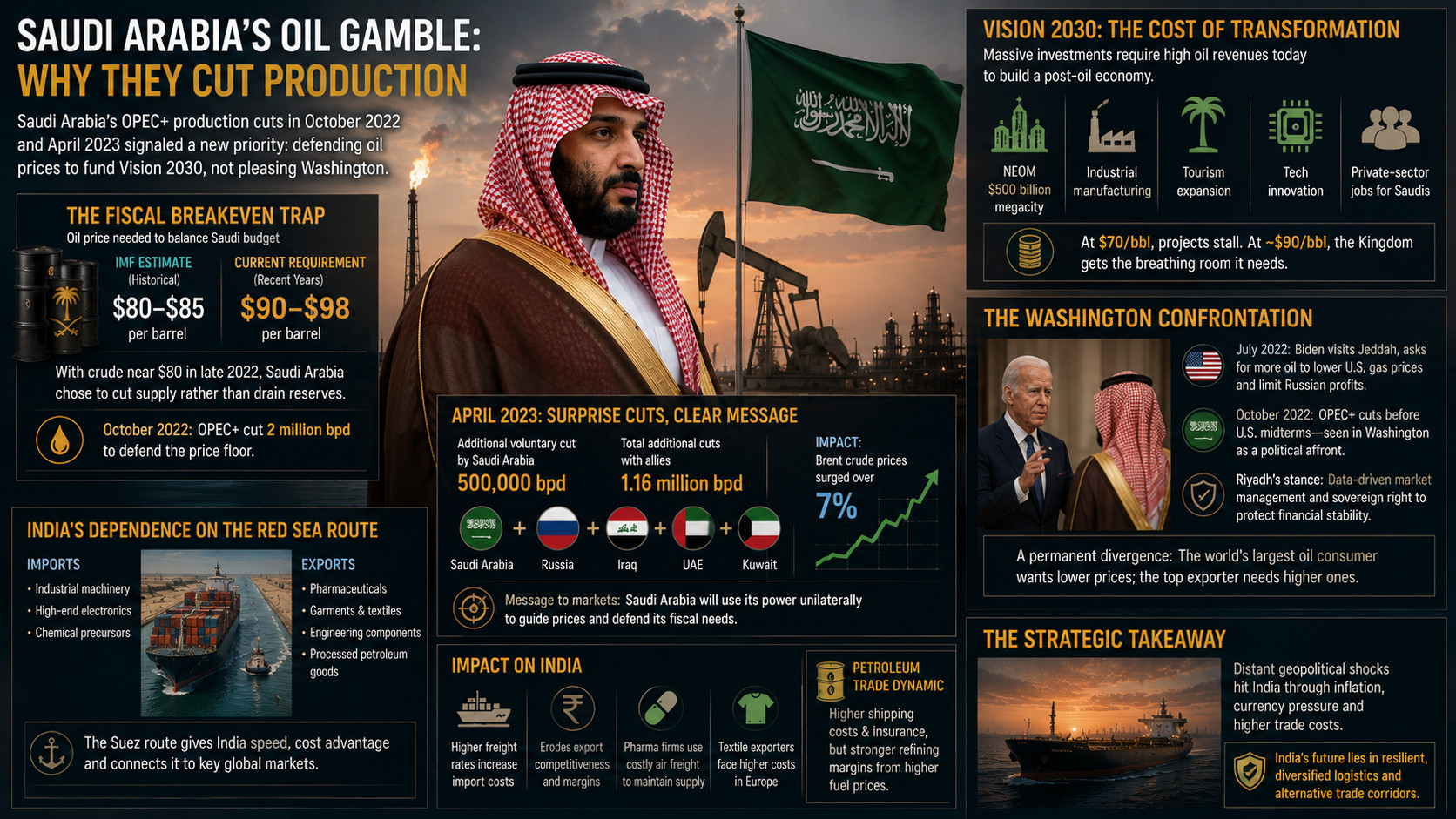
Saudi Arabia’s public finances remain highly linked to hydrocarbon exports, which supply roughly 70 percent of total government revenue. Historically, the International Monetary Fund (IMF) pegged the kingdom’s fiscal breakeven oil price—the price per barrel required to balance the national budget without drawing down sovereign assets—between $80 and $85. However, as the domestic spending commitments of the country's transformation agenda accelerated, the actual required price escalated considerably, moving near $90 to $98 per barrel in recent years.
When global crude prices slipped toward $80 in late 2022 amid recessionary demand forecasts, Riyadh faced a stark choice: absorb lower revenues and erode its foreign reserves, or restrict supply to build a firm price floor. The kingdom chose the latter. The October 2022 OPEC+ reduction of 2 million barrels per day (bpd) was explicitly deployed to prevent crude prices from breaching the structural floor required to keep the state budget solvent.
Vision 2030 and the True Cost of Transformation
The financial urgency behind these production decisions is magnified by the scale of Vision 2030—the economic diversification blueprint launched by Crown Prince Mohammed bin Salman. The initiative seeks to build an economy independent of oil, centered on:
- Localized industrial manufacturing
- International tourism
- Tech innovation
- Higher private-sector employment for Saudi nationals
However, building a post-oil economy requires an unprecedented up-front investment of hydrocarbon wealth. Flagship projects like NEOM, the $500 billion linear megacity, and the massive domestic infrastructure commitments of the Public Investment Fund (PIF) demand capital at a historic scale. During this delicate transition phase, oil revenue serves as the primary funding source. A price of $70 per barrel represents a severe fiscal constraint that threatens project timelines; a price near $90 provides vital strategic breathing room.
The Washington Confrontation
The October 2022 production rollback brought Saudi Arabia into direct political conflict with the Biden administration. Only months prior, in July 2022, President Biden had traveled to Jeddah to lobby for increased oil output to lower domestic retail gasoline prices and limit the energy export profits flowing to Russia during the Ukraine conflict.
OPEC+ choosing to cut supply weeks before the U.S. congressional elections was widely viewed in Washington as a political affront. Riyadh consistently maintained a firm rhetorical counter-position: OPEC+ decisions were driven entirely by data-based market management, and Saudi Arabia possessed an absolute sovereign right to protect its financial stability. The clash exposed a permanent structural divergence in the bilateral relationship: as the world's largest oil consumer, the United States relies on lower energy inputs, while Saudi Arabia, as a premier exporter, requires optimized per-barrel returns.
The April 2023 Surprise Interventions
While the 2022 cut was highly politicized, the surprise move in April 2023 was an explicit exercise of absolute market power. Defying statements from various OPEC+ officials who had suggested production policies would remain stable, Saudi Arabia announced an additional voluntary reduction of 500,000 bpd. This was closely matched by voluntary pullbacks from Russia, Iraq, the UAE, and Kuwait, removing a combined 1.16 million bpd from global supply. Following the announcement, Brent crude prices surged by over 7 percent.
This intervention served as a crucial geo-economic message. It demonstrated that Saudi Arabia was ready to utilize unilateral mechanisms to guide global energy pricing whenever it deemed market baselines unacceptable. For global energy markets, the maneuver reinforced a foundational reality: OPEC+ does not function as an impartial, market-neutral clearinghouse, but rather as an active pricing cartel structured around the fiscal requirements of its dominant player.
Summary Note: Saudi Arabia’s coordinated OPEC+ production cuts reflected a broader GeoFinance reality: modern energy markets are increasingly shaped not only by supply-demand mechanics, but by fiscal survival, geopolitical leverage, and the strategic priorities of major oil-exporting states.