
The India–US Trade Push: Structuring the New Supply Chain
The surging economic partnership between India and the United States signals a massive structural realignment of the global economy, driven by a mandate for supply chain resilience and the "China Plus One" strategy.
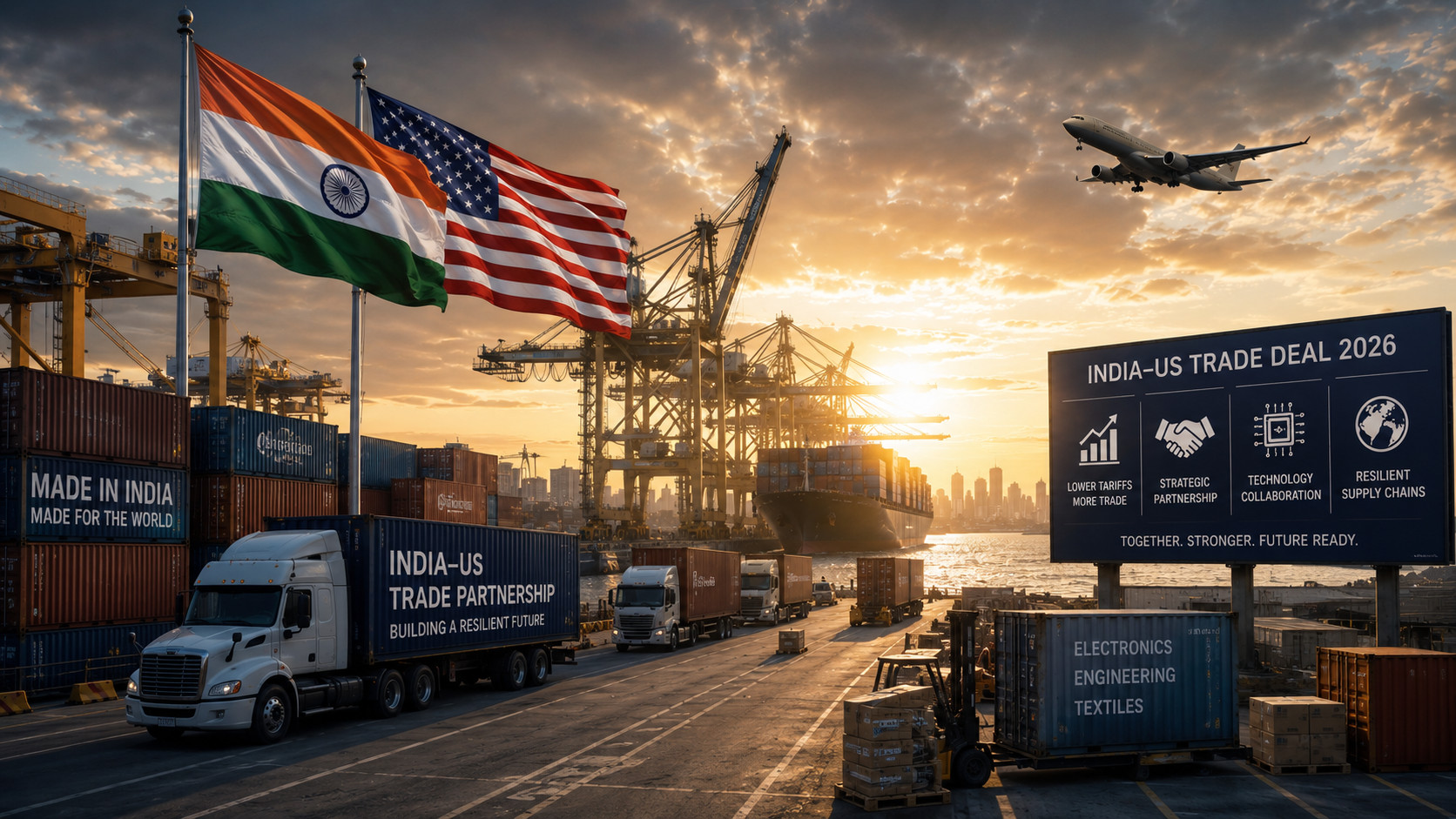
The India–US Trade Push
Trade agreements are typically viewed through the lens of short-term tariffs and market access. However, the surging economic partnership between India and the United States signals a massive structural realignment of the global economy.
For decades, supply chains prioritized absolute efficiency, concentrating manufacturing in high-scale, low-cost regions. Today, the new mandate is resilience. As geopolitical frictions and chokepoint vulnerabilities multiply, multinational corporations are actively diversifying.
India is emerging as a primary beneficiary of this global "China Plus One" migration.
The Architecture of the 2026 India–US Trade Deal
The bilateral trade agreement formalized a monumental reset in economic relations, directly lowering trade barriers to position India as a competitive manufacturing alternative.
[Previous Layered U.S. Tariffs] ─► Collapsed via 2026 Deal ─► [Standardized 18% Tariff Corridor] (Down from a nearly 50% Peak) ─► Drastically Boosts Margin Visibility for Exporters
The mechanics of this strategic trade-off are grounded in dual dependencies:
- The Tariff De-escalation: The U.S. collapsed punitive tariff layers from nearly 50% down to a flat 18% for Indian goods, giving Indian electronics, engineering, and textiles a sharp price advantage over regional competitors.
- The Energy Realignment: In exchange, India committed to phasing down its reliance on discounted Russian crude oil, re-routing its energy framework to absorb $500 billion in U.S. energy, technology, and aviation imports over the coming years.
Anchoring the "TRUST" Tech Corridor
Rather than focusing solely on traditional manufacturing, the partnership is driven by advanced industrial execution via the new TRUST framework (Transforming the Relationship Utilizing Strategic Technology):
- Electronics & Mobility: Propelled by the Production-Linked Incentive (PLI) schemes, India's electronics exports hit $22.2 billion in the first half of the fiscal year, positioning it as the country's second-largest export category.
- Semiconductors & AI: Under the India Semiconductor Mission (ISM) 2.0, global tech leaders are establishing massive semiconductor assembly, testing, and fabrication facilities domestically.
- Critical Minerals: Secure supply chains for lithium, rare earths, and gallium are being jointly developed to bypass traditional supply bottlenecks.
Diversification, Not Replacement
A common misconception is that India will completely replace China's industrial output. In reality, the corporate world is executing a "China Plus One" strategy.
China has spent decades building massive industrial ecosystems that cannot be replicated overnight. Global firms are keeping their primary operations intact while routing all incremental capacity expansions into India to mitigate single-geography risks. The objective is not total replacement; it is systemic diversification.
Structural Hurdles to Overcome
While the geopolitical winds favor India, domestic structural challenges dictate long-term execution:
- Logistical Friction: Enhancing port turnaround times and domestic freight rail connectivity.
- Component Localization: While assembly capacity has exploded, India still relies on heavy midstream component imports—crossing $100 billion in electronics imports this year alone.
- Regulatory Fluidity: Streamlining ease-of-doing-business parameters, compliance documentation, and clear foreign direct investment (FDI) guidelines.
GeoFinance Impact Matrix
| Metric | Impact | Description |
|---|---|---|
| Manufacturing CapEx Inflow | ↑ | Substantial Expansion |
| Supply Chain Concentration Risk | ↓ | Structurally Reduced |
| Bilateral Trade Velocities | ↑ | Targeting $500B by 2030 |
| Macro Resilience Value | ↑ | Prioritized Over Pure Cost |
The Bottom Line: The next chapter of globalization will not belong to a single factory floor. It will be defined by a resilient network of production hubs that balance low cost with high security—and India is successfully cementing itself as a core layer of that architecture.