
The "Japan Model": Navigating Debt, Aging, and Stability in the Modern World
For decades, Japan was viewed as an economic anomaly. Today, it serves as a critical preview of the structural challenges many nations face, balancing high debt, aging populations, and the shift from rapid expansion toward resilience-oriented economic management.
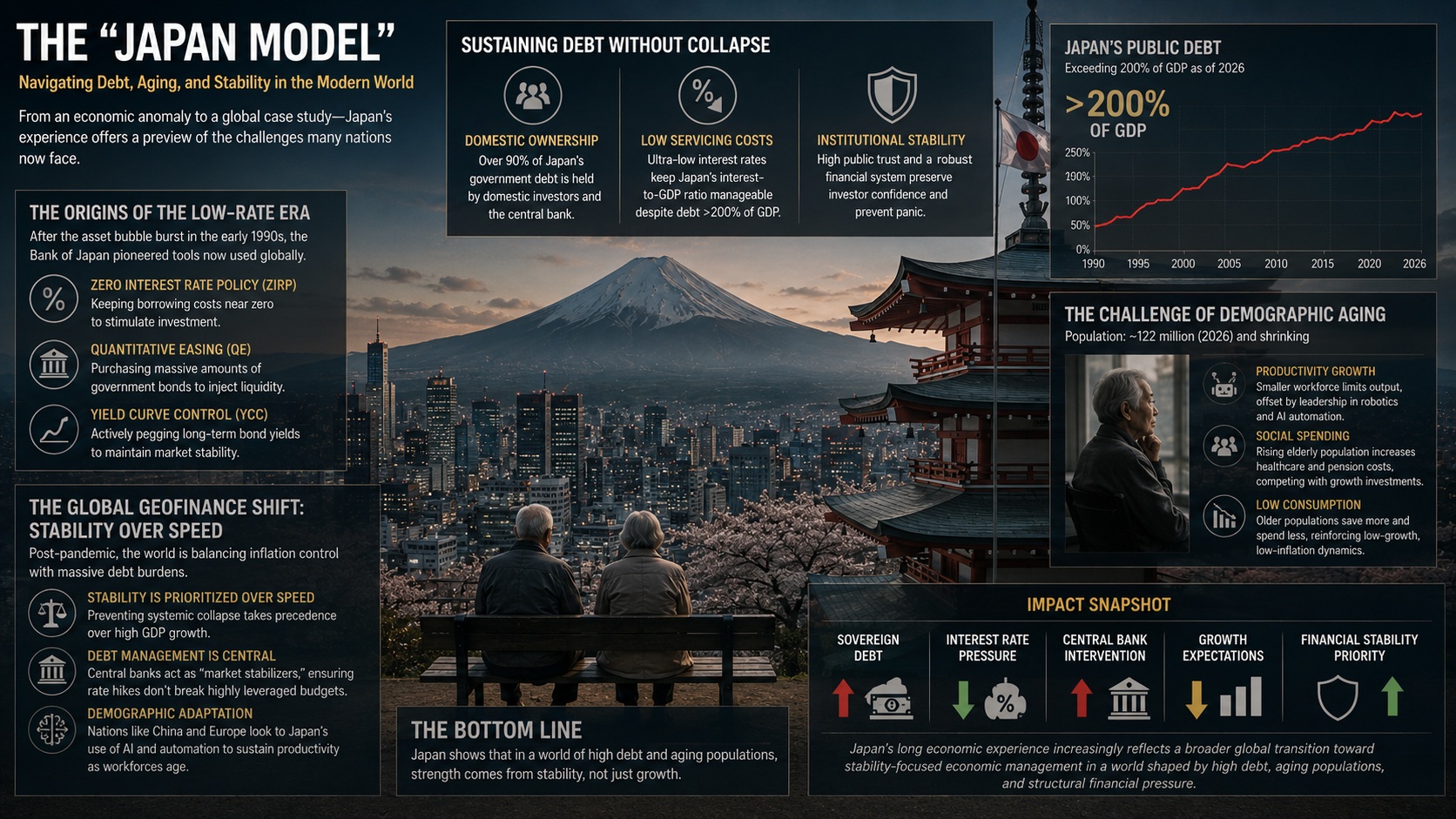
The "Japan Model": Navigating Debt, Aging, and Stability in the Modern World
For decades, Japan was viewed as an economic anomaly. After the collapse of its asset bubble in the early 1990s, the country entered a prolonged period of weak growth, deflationary pressure, and ultra-low interest rates. While most major economies focused on rapid expansion, Japan increasingly prioritized financial stability and debt management.
Today, as global debt levels reach historic highs and advanced economies struggle with aging populations and persistent fiscal pressure, the “Japan model” is no longer seen as an exception. Instead, it serves as a critical preview of the structural challenges many nations are now beginning to confront.
The Origins of the Low-Rate Era
Japan’s economic slowdown began after one of the largest financial bubbles in modern history burst in the early 1990s. As equity and real estate markets collapsed, the Bank of Japan (BoJ) pioneered extraordinary monetary measures that have since become global standards:
- Zero Interest Rate Policy (ZIRP): Keeping borrowing costs near zero to stimulate investment.
- Quantitative Easing (QE): Injecting liquidity by purchasing massive amounts of government bonds.
- Yield Curve Control (YCC): Actively pegging long-term bond yields to maintain market stability.
While these tools were initially seen as radical, they are now common in the playbooks of the U.S. Federal Reserve and the European Central Bank.
Sustaining Debt Without Collapse
One of the most remarkable aspects of Japan’s economy is its ability to maintain the world’s highest public debt—exceeding 200 percent of its GDP as of 2026—without triggering a sovereign crisis. Several structural factors have acted as stabilizers:
- Domestic Ownership: A significant majority of Japanese government debt is held by domestic investors and the central bank, shielding the country from volatile international capital flights.
- Low Servicing Costs: By keeping rates suppressed, the government has managed to keep its interest-to-GDP ratio manageable despite the massive principal debt.
- Institutional Stability: High levels of public trust and a robust financial system have preserved global investor confidence, preventing the panic often seen in other high-debt nations.
The Challenge of Demographic Aging
Japan is the first major economy to experience the full impact of demographic aging. As of 2026, its population stands at approximately 122 million and continues to shrink. This shift creates a "demographic deficit" that pressures the economy in three ways:
- Productivity Growth: A smaller workforce naturally limits total output, though Japan has offset this by leading the world in robotics and AI automation.
- Social Spending: Rising elderly populations demand increased expenditure on healthcare and pensions, competing with growth-oriented investments.
- Low Consumption: Older populations tend to save more and spend less, reinforcing a low-growth, low-inflation environment.
The Global GeoFinance Shift: Stability Over Speed
The relevance of Japan’s experience has peaked in the post-pandemic era. Governments worldwide are facing a similar "balancing act" between controlling inflation and managing massive debt burdens accumulated during COVID-era stimulus.
We are witnessing a broader global transition from growth-driven economics toward resilience-oriented economic management. In this new reality:
- Stability is prioritized over speed: Policymakers are more concerned with preventing systemic collapse than achieving high GDP growth.
- Debt Management is Central: Central banks are increasingly acting as "market stabilizers," ensuring that interest rate hikes do not break highly leveraged government budgets.
- Demographic Adaptation: Nations like China and parts of Europe are now looking to Japan's success in integrating AI and automation to sustain productivity as their own workforces begin to age.
The Bottom Line
For years, Japan was treated as a warning of what happens when growth dies. Today, it is better understood as a case study for the future. The larger GeoFinance lesson is that in a world of high debt and aging populations, national strength is no longer determined solely by rapid expansion, but by the ability to remain stable and resilient under immense structural pressure.
Japan’s long economic experience increasingly reflects a broader global transition toward stability-focused economic management in a world shaped by high debt, aging populations, and structural financial pressure.