
The Sovereign Dollar: Financial Weaponization and the Infrastructure of Hegemony
The United States dollar functions as the unrivaled gravity well of global macroeconomics. By restricting a state's access to the technical networks that clear dollar transactions, the U.S. transforms financial interdependence into a powerful coercive tool, accelerating global financial fragmentation.
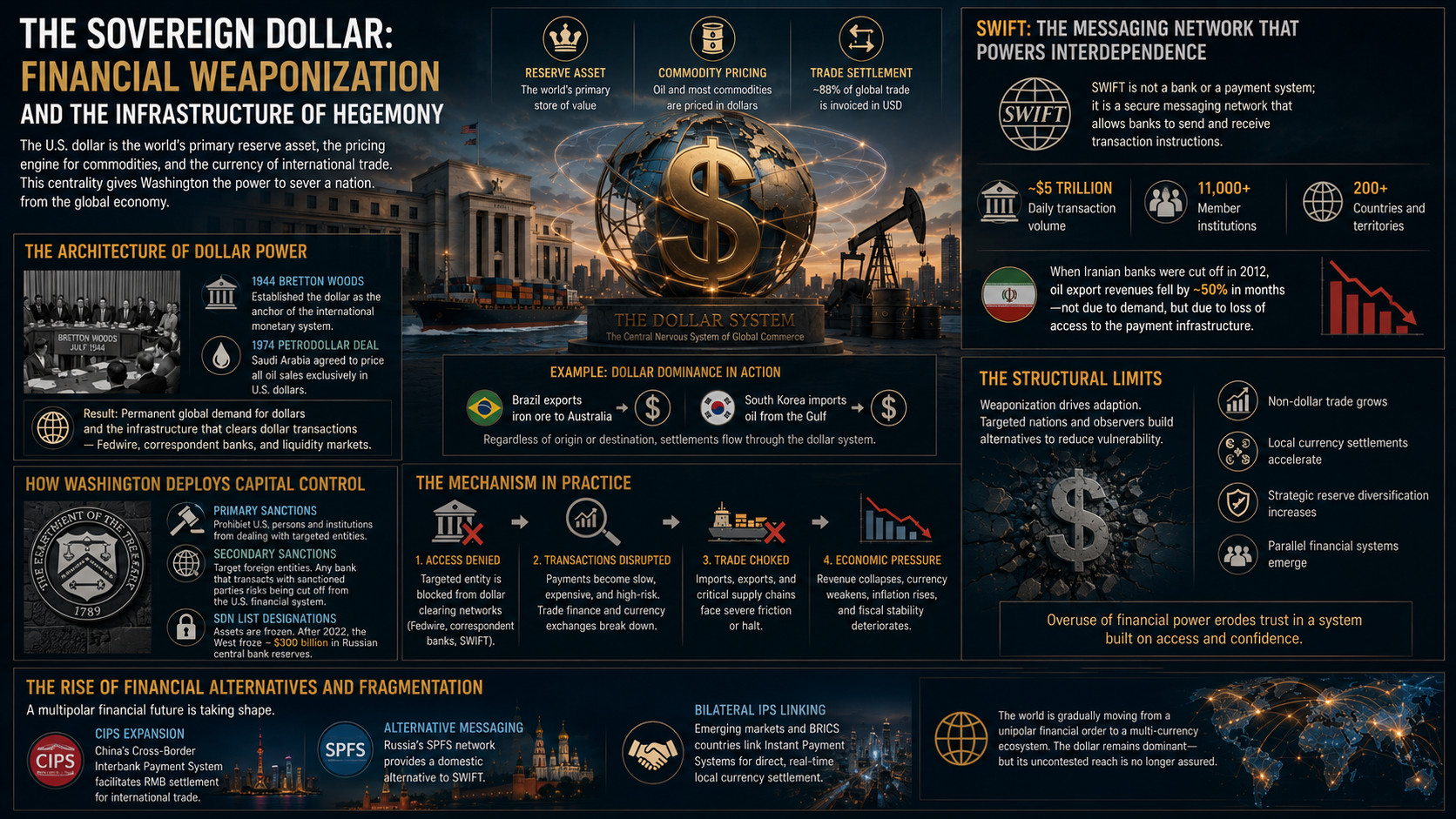
The Sovereign Dollar: Financial Weaponization and the Infrastructure of Hegemony
The United States dollar functions as the unrivaled gravity well of global macroeconomics. It serves as the world's primary reserve asset, the mandatory pricing mechanism for crude oil and industrial commodities, and the medium in which the overwhelming majority of international trade is settled.
This structural centrality grants Washington a unique form of statecraft that no conventional military projection can replicate: the capacity to effectively sever a sovereign nation from the global economic matrix. By restricting a state's access to the technical networks that clear dollar transactions, the United States transforms financial interdependence into a powerful coercive tool. Understanding the technical architecture of this mechanism—and its structural limits—is essential for interpreting modern GeoFinance shifts.
Why the Dollar is the Weapon
The global dominance of the greenback is not merely a passive market preference; it is the deliberate product of mid-20th-century institutional engineering. The 1944 Bretton Woods agreement formally positioned the dollar as the anchor currency of international finance. This status was augmented by the 1974 petrodollar arrangement, under which Saudi Arabia and other major oil producers agreed to invoice all global oil sales exclusively in U.S. dollars, hardwiring a permanent, baseline global demand for the currency.
The mathematical consequence of this framework is that the vast majority of cross-border commerce—even transactions featuring zero physical connection to American soil—is denominated and cleared in dollars:
- When a Brazilian conglomerate exports iron ore to an Australian steel mill, the ledger is typically settled in U.S. funds.
- When a South Korean refinery imports crude from a Gulf nation, the settlement occurs via dollar accounts.
Because of this systemic reality, the underlying infrastructure of dollar clearing—most notably the Federal Reserve’s Fedwire system and the vast network of international correspondent banks that maintain dollar accounts—forms the central nervous system of global commerce. To deny a foreign entity access to this infrastructure is to systematically halt its capacity to engage in modern international trade.
SWIFT: The Messaging Network That Powers Interdependence
While many recognize that being disconnected from SWIFT constitutes a severe financial penalty, its precise role as a network hub is frequently misunderstood. The Society for Worldwide Interbank Financial Telecommunication (SWIFT) is neither a bank nor an actual fund-transfer platform; it is a secure, standardized global communication network.
When a financial institution in Mumbai executes an international transfer to a bank in Frankfurt, SWIFT transmits the heavily encrypted, standardized data message required to authorize and verify the transaction. The network facilitates massive capital flows:
| Attribute | Details |
|---|---|
| Daily Transaction Volume | Approximately $5 trillion in interbank instructions |
| Global Footprint | Exceeds 11,000 member institutions |
| Geographic Reach | Operates across more than 200 countries and territories |
Exclusion from SWIFT does not vanish a country's domestic capital; rather, it strips that nation of the standardized linguistic infrastructure required to interface with international banking. Cross-border settlement, trade finance documentation, and currency exchanges become incredibly complex, slow, and expensive to execute. For example, when Iranian banks were disconnected from the network in 2012, the country's oil export revenues fell by roughly 50 percent within a matter of months—not due to a lack of demand for the commodity, but because the processing mechanism for international payments had been structurally severed.
How Washington Deploys Capital Control
The United States exercises its dollar-based financial leverage through a highly organized matrix overseen by the Department of the Treasury’s Office of Foreign Assets Control (OFAC):
- Primary Sanctions: Direct legal prohibitions that prevent U.S. citizens, domestic corporations, and American financial institutions from engaging in any business with designated entities or nations.
- Secondary Sanctions: Extraterritorial legal mandates that target non-U.S. individuals and overseas corporations. This is where the dollar’s network effects act as a coercive tool. Any foreign bank that processes a transaction for a sanctioned entity faces complete exclusion from the U.S. financial system. Because losing access to dollar clearing is a commercial death sentence for any global tier-one bank, international institutions strictly enforce American mandates worldwide.
- SDN List Designations: Placement on the Specially Designated Nationals (SDN) registry. This action triggers an immediate freeze of all properties, securities, and central bank assets falling within U.S. legal jurisdiction. Following the 2022 geopolitical escalation, this specific mechanism allowed Western coalitions to instantly immobilize approximately $300 billion in liquid sovereign foreign exchange reserves belonging to the Russian central bank.
The Structural Limits and the Rise of Fragmentation
The deployment of financial statecraft is exceptionally potent, but it is bound by a distinct paradox: the more frequently the tool is weaponized, the faster targets and observers alter their behavior to avoid it. The post-2022 financial environment demonstrated that a major G20 commodity exporter could withstand aggressive financial isolation by rapidly rerouting its trade toward non-sanctioning, systemic economies like China and India, frequently shifting transaction settlement away from the dollar entirely.
This defensive repositioning has accelerated the development of parallel, non-Western financial networks designed to insulate sovereign capitals from unilateral jurisdiction:
- CIPS Expansion: China’s Cross-Border Interbank Payment System (CIPS) has seen elevated transaction volumes as an alternative settlement clearing mechanism for renminbi-denominated trade.
- Alternative Messaging: Russia’s domestic equivalent to SWIFT, the SPFS network, has been integrated across localized banking corridors.
- Bilateral Instant Payment Linking: A growing push within emerging markets and the BRICS bloc seeks to link national Instant Payment Systems (IPS) directly to one another. This allows direct, real-time local currency conversion without utilizing the U.S. dollar as an intermediate vehicle currency.
While these alternative structures do not currently rival the deep liquidity, legal transparency, and systemic convenience of the traditional dollar-SWIFT architecture, the broader trajectory is undeniable. The willingness to utilize the international monetary system as a geopolitical lever is driving a gradual, structural fragmentation of global payments, slowly transitioning the world from a unipolar financial order into a multi-currency ecosystem.